Corporate event ideas: 25 formats for teams, clients & partners
A successful corporate event takes more than a great program. It should match the occasion, the guests, and the objective of the event. While an internal kick-off can bring new energy to the team, a customer event focuses more on interaction and brand impact. At a partner event, on the other hand, personal conversations and good networking opportunities are particularly important.
From strategic workshops and product presentations to quiz nights or rooftop events: We show you 25 corporate event ideas that can be implemented in a modern event venue – professional, creative, and sometimes surprisingly different.
25 corporate event ideas for different occasions
Which corporate event is the right one depends primarily on what you want to achieve. Do you want to share knowledge, present a new product, strengthen team cohesion, or maintain relationships with customers and business partners? The following ideas show just how diverse a corporate event can be.
Strategic & professional: corporate events with a clear business focus
1. Kick-off event: Start a new project together
A kick-off event brings everyone involved together at the start of a project, financial year, or important phase for the company. In addition to presentations, workshops, breakout sessions, and joint planning rounds can form part of the program.
It is important not to fill several hours exclusively with presentations. Alternating between short input sessions, collaborative work, and breaks helps participants stay engaged. Flexible spaces are particularly useful for this: After a shared opening session, smaller groups can move into different areas and then come back together to consolidate their results.
2. Strategy offsite: Create distance from day-to-day work
A strategy offsite deliberately gives teams and managers space outside the traditional office environment. The focus may be on annual goals, new business areas, positioning, or important decisions.
However, a change of location alone does not make for a successful strategy day. Goals, key questions, and responsibilities should be clearly defined in advance. At the same time, the agenda should leave enough room for discussion. Especially with complex topics, important insights often emerge not during a presentation but in the conversations in between.
3. Innovation Day or Future Lab
What will our company look like in three years? Which developments are changing our industry? And which ideas should we start testing today? At an Innovation Day, employees, customers, or partners explore future-focused topics together.
The format works particularly well with short impulses followed by working sessions. Different areas of the event venue can be used as themed stations. This can create dedicated spaces for ideation, prototyping, discussion, and presentations.
To ensure the Innovation Day becomes more than just a collection of ideas, concrete next steps should be defined at the end: Which idea will be pursued further? Who will take responsibility? And when will progress be reviewed?
4. Town Hall or All-Hands event
At a Town Hall, management informs larger teams about company developments, goals, or changes. At the same time, the format provides an opportunity for questions and open dialogue.
Technology plays a particularly important role here. Good visibility of presentations, reliable audio, and, where necessary, the option for hybrid participation should be planned at an early stage. A moderated Q&A session or questions submitted anonymously in advance can also help ensure that the conversation is not dominated exclusively by the most outspoken participants.
5. Leadership Roundtable
A Leadership Roundtable is aimed at executives or selected decision-makers. Instead of large-scale presentations, the focus is on conversation. Topics may include leadership, transformation, corporate culture, or current industry challenges.
Small groups and a high-quality, quiet environment create the right setting. A roundtable can also be combined effectively with a shared dinner or a networking session afterwards.
Corporate event ideas for customers and business partners
6. Product presentation or launch event
A new product, a new service, or a rebranding often deserves more than a presentation via video call. A launch event brings new developments to life while also creating space for personal conversations with customers, the press, or business partners.
The venue should support the brand without stealing the spotlight. Presentation technology, customised setups, and different areas for product showcases, conversations, and catering help create a varied event experience.
7. Customer workshop and co-creation session
Customers do not have to be mere guests at a corporate event. In a co-creation session, they are deliberately involved in developing new products, services, or processes.
In small groups, participants can identify needs, evaluate ideas, or develop concrete concepts. This provides companies with valuable input while also demonstrating that customer perspectives are taken seriously.
It is important to ask for feedback only when there is also a clear plan for communicating what happens with it afterwards. Participation without a visible outcome can quickly feel like little more than a marketing exercise.
8. Partner Summit
A Partner Summit brings together important business partners, service providers, or sales partners. Professional content can be combined with company updates, workshops, and networking.
Especially when guests come from different companies, enough time should be reserved for personal conversations. A tightly scheduled conference day with one presentation after another leaves little room for this. Small conversation areas, a rooftop terrace, or a shared closing session can be just as important as the official program.
9. Expert Talk or Fireside Chat
An Expert Talk is ideal for companies that want to share knowledge while encouraging personal interaction. An expert provides a short introduction, followed by a moderated conversation.
Compared with a traditional keynote, a Fireside Chat often feels more personal and less formal. The format is suitable for customer events as well as internal events or partner events. Networking afterwards turns the expert session into a complete evening event.
10. Customer evening with networking
Not every customer event needs an extensive stage program. A high-quality customer evening can deliberately focus on encounters and conversations.
A short welcome, good catering, subtle music, and different areas for sitting or standing are often enough. The host role is crucial: Employees should not only talk among themselves but actively connect guests and facilitate conversations.

Communicative & interactive: formats that get people talking
11. World Café
The World Café format is suitable for larger groups when multiple perspectives on a particular question are needed. Small groups discuss different topics at several tables. After a set period of time, participants move on to the next table.
The format works just as well internally as it does with customers or business partners. Well-formulated questions are particularly important. The more specific they are, the more likely it is that the discussions will produce results that can actually be used afterwards.
12. Barcamp
At a Barcamp, the program is not fully defined in advance. At the beginning, participants suggest their own topics and then organise the individual sessions themselves.
This makes the format particularly interactive, but it also requires openness. For groups that are only familiar with traditional conferences, the concept should be explained clearly beforehand.
Several flexible areas are ideal for a Barcamp: Depending on their interests, participants can spread out across different sessions and come back together later.
13. Speed Networking
Speed Networking applies the concept of short encounters to a business setting. At fixed intervals, two people speak to each other before moving on to the next round.
It is particularly suitable for events where many guests do not yet know one another. Conversation prompts prevent every round from starting with the same standard questions. Afterwards, there should always be time for open networking – after all, interesting conversations cannot be limited to five minutes.
14. Pecha Kucha evening
With Pecha Kucha, presentations are deliberately short and visual. The classic format uses a limited number of slides that advance automatically. This creates concise presentations without endless text-heavy slides.
Companies can interpret the concept a little more flexibly and invite employees, customers, or partners to present short stories, projects, or ideas for the future. This creates variety and gives several people a platform.
15. Quiz night with company or industry-related topics
A quiz night combines entertainment with communication and can be tailored individually to the occasion. In addition to general knowledge, categories may include industry questions, music, estimation questions, or humorous questions about the company.
For customer events, internal insider questions should be used sparingly. Categories in which different guests can contribute their knowledge are more engaging. Mixed teams also help create new connections.
Creative and unusual corporate event ideas
16. Art Night
During an Art Night, the event venue becomes a temporary studio. Employees, customers, or partners can create their own canvases or work together on a larger piece of art.
The format is particularly suitable as a deliberate contrast to a content-heavy daytime program. Artistic talent should not be a requirement. Professional guidance can make it easier to get started and prevent less creative participants from feeling uncomfortable.
17. Escape Game Challenge at the event venue
Solving puzzles together, combining clues, and making decisions under time pressure: An Escape Game is particularly suitable for teams, but can also work as an interactive element at a partner or customer event.
The challenge can be set up directly at the event venue. Depending on the group size and concept, individual areas can be separated and used as different puzzle stations. This allows several groups to play at the same time without having to change locations during the event.
18. Team Chain Reaction
In a Team Chain Reaction, different groups develop individual sections of one large mechanical reaction. Balls roll down ramps, dominoes trigger new movements, and self-designed elements connect the individual stations.
At the end, all sections are combined. That is precisely what makes the format appealing: Each group initially works independently, but the final success depends on all the transitions working together.
The format requires sufficient space and preparation time, but it can be integrated effectively into different areas of an event venue.
19. Mini golf on the rooftop terrace
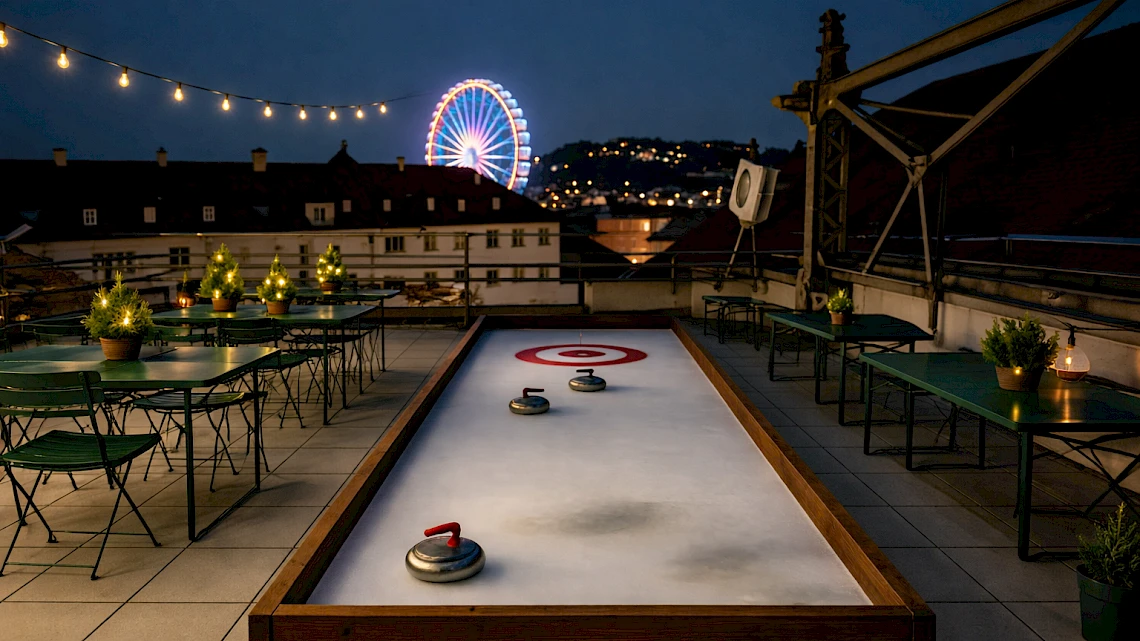
A mobile mini-golf course on the rooftop terrace adds movement to a corporate event without requiring outstanding athletic ability. Small groups can compete against each other while still having plenty of opportunities for conversation between holes.
The format is particularly suitable for summer events, after-work events, or as a relaxed conclusion to a workshop. An indoor alternative should always be planned in case of bad weather.
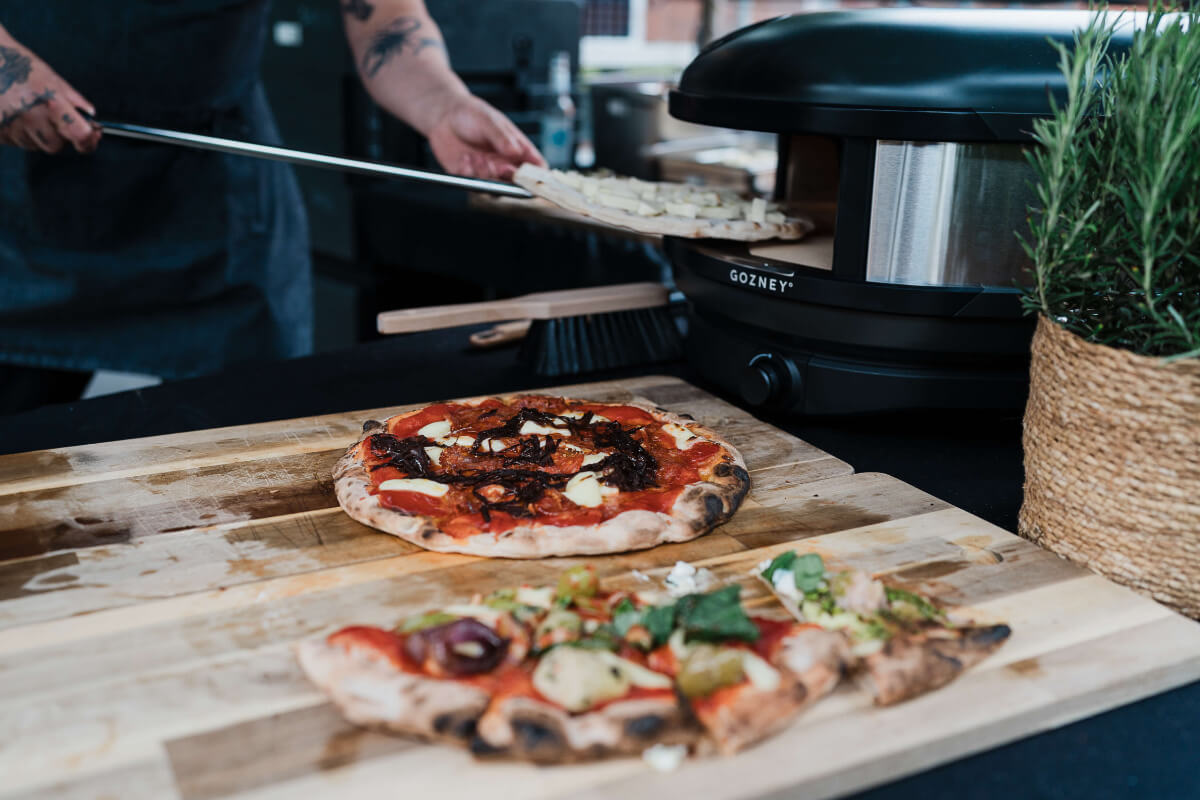
20. Create-your-own event with pizza, pinsa, or burgers
Top, combine, and enjoy together: At a create-your-own event, small groups design their own pizza, pinsa, or burger creation.
The format combines food with an uncomplicated activity and is therefore well suited to teams as well as relaxed customer or partner events. If desired, it can be turned into a small challenge, with teams naming their creations or presenting them to the group.
Vegetarian and vegan alternatives as well as allergies should, of course, be taken into account during the planning stage.
Food, drink & shared experiences
21. Barista course
A barista course is a corporate event for anyone who wants to combine learning with enjoyment. Participants learn more about coffee beans, grind size, espresso, and milk foam before trying the techniques themselves.
The format works particularly well in smaller groups or as one station within a larger event. Coffee should not be the only option available. Decaffeinated alternatives, tea, and plant-based milk options make the experience more inclusive.
22. Cocktail or mocktail workshop
During a cocktail workshop, guests learn about different ingredients, techniques, and combinations. The format becomes even more flexible when cocktails and high-quality alcohol-free mocktails are offered on an equal footing.
Especially at corporate events, alcohol should never be a requirement for participation. A good workshop works regardless of alcohol content and focuses on flavour, creativity, and experimenting together.
23. Culinary tasting
Coffee, chocolate, spices, or other specialities: A guided tasting can take place as a standalone corporate event or as part of a longer program.
The format is particularly pleasant for customers and partners because it creates a shared experience without requiring guests to participate in a playful activity. At the same time, conversation topics emerge almost automatically.
24. Dinner event with quiz, mystery, or storytelling elements
If you want to make a traditional dinner more interactive, you can combine it with short quiz questions, storytelling, or a mystery concept. Between individual courses, guests receive tasks, clues, or short prompts.
To prevent the dinner from becoming one continuous activity, less is often more. Particularly with customers and partners, there should be enough time for personal conversations. The interactive elements provide conversation starters – they should not replace networking.
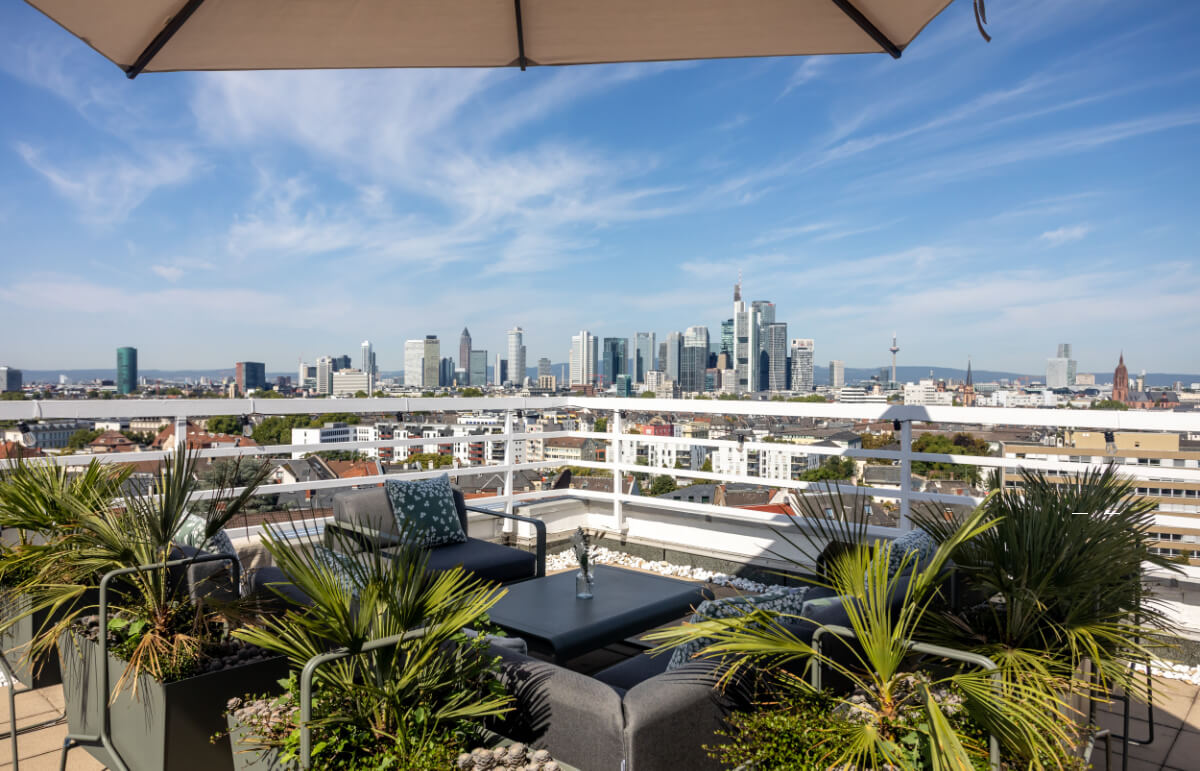
25. Rooftop after-work event with catering and music
After a workshop, conference, or presentation, simply change the atmosphere: A rooftop after-work event is an excellent way to conclude a corporate event.
Good catering, drinks, subtle music, and views over the city create a relaxed setting for conversations. Particularly at customer and partner events, the volume should be kept at a level that still allows for easy networking.
Depending on the venue, rooftop terraces can be a special highlight of the event. However, a suitable bad-weather alternative should always be part of the planning.
Which corporate event idea is right for which objective?
The best corporate event idea is not necessarily the most unusual one. What matters is the objective you want to achieve with the event.
For team bonding and collaboration, interactive formats such as an Escape Game, Team Chain Reaction, Art Night, or create-your-own event are suitable. If the aim is to share knowledge or develop a common direction, a kick-off, strategy offsite, Innovation Day, or World Café may be a better fit.
At a customer event, added value and the host role are the main priorities. Expert Talks, co-creation workshops, product launches, and high-quality networking evenings combine professional value with personal interaction.
For business partners, formats that enable conversations on an equal footing work particularly well. A Partner Summit, Leadership Roundtable, Fireside Chat, or a shared evening with catering creates the right setting.
A playful format is therefore not automatically better than a professional one. For a group of long-standing partners, a good dinner with interesting conversations may be more valuable than an elaborate challenge. Conversely, an interactive activity after a long conference day may provide exactly the right change of perspective.
Corporate events for teams, customers, or partners: What matters?
Corporate events for employees
Internal corporate events often focus on motivation, interaction, and shared experiences. The program should take different personalities into account and should not pressure anyone into sporting, creative, or personal activities.
Formats that offer several ways to participate and leave enough free time for conversation work particularly well.
Customer events
A customer event should offer guests genuine added value. This may come in the form of knowledge, access to experts, a special experience, or the opportunity to exchange ideas with other companies.
Your own brand can certainly be visible – but it should not dominate every minute of the event. If you invite customers, being a good host should come first.
Partner events
At a partner event, the relationship takes centre stage. Professional exchange is important, but there should also be enough room for personal conversations.
A high-quality setting, good accessibility, and different areas for presentations and networking are often more important here than the most unusual entertainment program possible.
How to plan a corporate event that truly fits the occasion
Start with the objective, then choose the format
Do not start with the question “What could we do?” but with “What should be different after the event?”. Do you want to inform people, strengthen relationships, make decisions, create new connections, or simply celebrate together?
Only once the objective is clear can you choose a suitable corporate event idea.
Consider the number of participants and the target audience
A workshop with twelve people requires a different setup from a customer event with one hundred guests. In addition to the number of participants, you should also consider how well they know one another and how actively they should be involved.
Do not overload the schedule
Five program items are not automatically better than three. Especially at networking events, free time is often underestimated. Make sure to deliberately plan breaks and periods without a moderated program.
Think of catering as part of the event
Food and drinks are more than just refreshments. Coffee breaks, lunch, or dinner are important moments for conversation. Catering should therefore fit the daily schedule and include vegetarian, vegan, and any other required options.
Clarify technical requirements early
Presentations, microphones, audio, video conferencing, or music should be tested before the event. Particularly at a product launch or Town Hall, a technical issue can disrupt the entire event.
Plan a bad-weather alternative
Rooftop terraces are a highlight – but the weather remains unpredictable. For outdoor activities, a realistic indoor alternative should therefore be planned from the outset.
Choose moderation that suits the format
A customer talk, a strategic workshop, and a quiz night require different styles of moderation. For complex or sensitive topics, an external moderator may be useful. An entertaining evening, on the other hand, mainly needs someone who can guide the program confidently and with a relaxed approach.
Leave time for conversations
Especially at customer and partner events, the most valuable moments often cannot be planned. An interesting conversation after a presentation or an exchange during dinner can be more important in the long term than adding another item to the program.
The right event venue for your corporate event
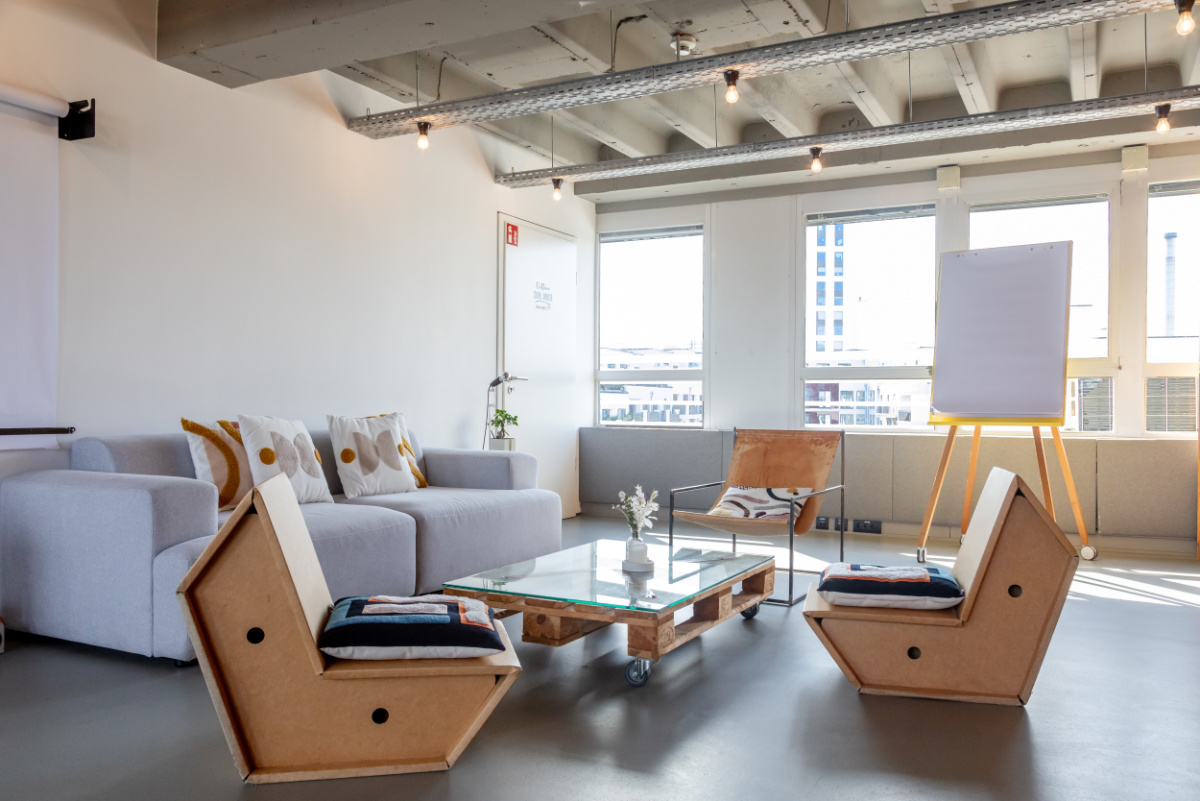
A good event venue should suit the planned format – not the other way around. Flexible room concepts are particularly useful for modern corporate events. This allows presentations, workshops, breakout sessions, catering, and networking to take place within the same venue.
When choosing a venue, consider factors such as natural daylight, acoustics, presentation technology, flexible furniture, catering options, and a central, easily accessible location. For larger events, different areas are useful so that groups can work in parallel or switch between focused and communicative phases.
The OutOfOffice event venues in Munich, Frankfurt, and Stuttgart combine inspiring loft-style interiors with modern technology and flexible spaces. Depending on the corporate event, areas can be separated for workshops or challenges and then opened up again for a shared program afterwards.
Different phases of an event can also be combined: a strategy workshop in the morning, interactive sessions in the afternoon, followed by a shared conclusion with catering. This keeps the entire corporate event in one location and means guests do not have to move between multiple venues.
- Event venues in Munich provide an exceptional setting for corporate events right in the heart of the city.
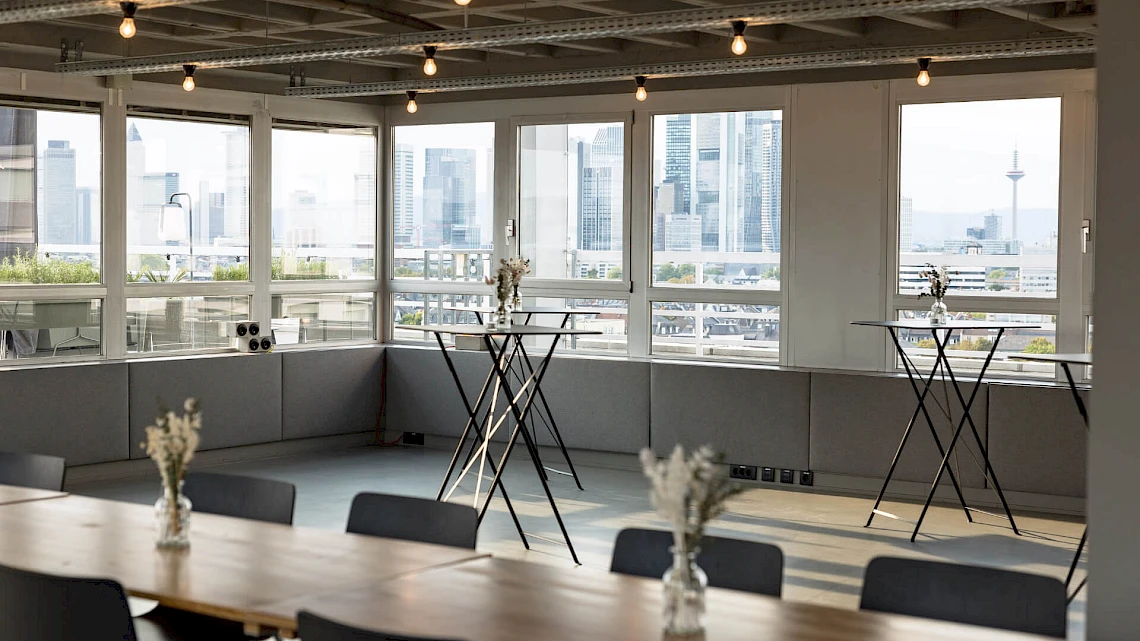
- Event venues in Frankfurt also offer views of Frankfurt's famous skyline.
- The event venue in Stuttgart combines an urban atmosphere with a rooftop terrace and views over the historic old town.
FAQ: Frequently asked questions about corporate events
Corporate events can be organised with a professional, creative, culinary or interactive focus. Typical formats include kick-offs, workshops, client events, product launches, networking evenings, quiz nights, creative workshops or shared dining experiences. The key is to ensure that the concept is suited to the objective and the guests.
Formats that offer clear added value are particularly well-suited to clients, such as expert talks, product presentations, co-creation workshops, tastings or high-quality networking evenings. Entertainment can complement the event, but should not detract from the host’s actual role.
For larger groups, options include town hall meetings, innovation days, World Cafés, quiz nights, BarCamps and networking events. Ideally, the whole group can be split into smaller groups for individual programme items.
That depends on the format. An Expert Talk with networking can last two to three hours, whilst a strategy off-site or partner summit can take a whole day. It is essential to allow enough time for breaks and informal discussions.
The costs depend, amongst other things, on the number of attendees, duration, venue, catering, technical requirements, equipment and external programme partners. An in-house workshop format can be significantly cheaper than a large-scale product launch. A bespoke quote is therefore usually more informative than a flat rate per person.
First, define the objective, target audience, budget and number of attendees. Next, select the format, event venue, programme, catering, technical requirements and, if necessary, external suppliers. Responsibilities and a detailed timetable should be finalised before the day of the event.
Workshops, escape games, quiz nights, art nights, tastings, barista courses and many networking formats can be held entirely indoors. For events held on a roof terrace, an indoor alternative should always be planned as a backup.
It is best to keep the two elements clearly separate. For example, a morning of professional sessions could be followed by an interactive afternoon and then a group dinner. This ensures there is sufficient focus on business topics, whilst still providing an engaging experience.